
Mont-Tremblant National Park: The Complete Visitor Guide

- October 31, 2026
- 9
- Things to Do
Ask anyone who knows the Laurentides where to find real wilderness close to Montreal and the answer is almost always the same: Mont-Tremblant National Park. Not to be confused with the ski resort a few kilometres away, the park is a vast protected territory of lakes, rivers, waterfalls and forested hills where moose outnumber shops. This guide explains how the park is organized, what to do in each season, and how to plan a smooth visit, whether you have a single afternoon or a full week.
Key takeaways
- Created in 1895, Mont-Tremblant is the first park established in Quebec and covers roughly 1,510 square kilometres.
- It is divided into three sectors, Diable, Pimbina and Assomption, each with its own entrance and character.
- The Diable sector, closest to the village of Mont-Tremblant, is the easiest starting point for first-time visitors.
- Summer brings hiking, beaches, canoeing and a via ferrata; winter brings cross-country skiing and snowshoeing.
- The park is managed by Sépaq: an access fee applies and camping must be reserved, often well in advance.
Mont-Tremblant National Park at a glance
The park was created in 1895, which makes it the oldest of Quebec’s national parks. Today it protects about 1,510 km² of Laurentian landscape with more than 400 lakes, several major rivers and a rich population of wildlife. Around 40 species of mammals live here, including moose, white-tailed deer, black bear, red fox, beaver and the eastern wolf, which is the park’s emblem. Birdwatchers can count on a long list of species, especially around wetlands and lakeshores in late spring.
Like other Quebec national parks, it is operated by the Société des établissements de plein air du Québec (Sépaq). That means a daily access fee, marked trails, staffed visitor centres in the main sectors, and campgrounds that range from serviced sites to backcountry spots reached by canoe or on foot.
Understanding the three sectors
The park is so large that it is best thought of as three separate destinations. Driving from one sector to another can take a long time, so pick one base per day.
| Sector | Best for | Character |
|---|---|---|
| Diable | First visits, day trips, families | The most developed sector, around Lac-Monroe and the Diable River valley, with beaches, short and medium hikes, rentals and the via ferrata. |
| Pimbina | Quieter lakes, camping, paddling | Reached from the Saint-Donat side; lakes, beaches and trails with fewer crowds than Diable. |
| Assomption | Remote feel, longer stays | The most secluded sector, in the Assomption River valley, suited to visitors looking for tranquility and backcountry experiences. |
Best things to do in summer
Hike La Roche for the classic view
In the Diable sector, the La Roche trail is the park’s signature hike. It climbs above Lac-Monroe to lookouts over a glacial valley, lakes and the rolling Laurentian hills. Many hikers combine it with the neighbouring La Coulée and La Corniche trails for a longer loop of moderate difficulty. Start early on summer weekends: the trailhead is popular and the morning light on the lake is worth it.
See the Chute du Diable
If you are visiting with young children or simply want an easy outing, the short walk to the Chute du Diable waterfall is a good choice. The Diable River is also the backdrop for some of the park’s most photographed scenery in early October, when the maples turn red and orange. For timing tips, read our guide to fall colours in the Laurentides.
Climb the via ferrata
The Via Ferrata du Diable lets visitors climb a rock face on La Vache Noire mountain using steel rungs, cables and suspension bridges, with a guide and full safety equipment. It operates during the warm season only and requires a reservation. No climbing experience is needed, but you should be comfortable with heights.
Swim and paddle
The park’s sandy beaches, such as the one on Lac-Monroe, are perfect after a hike. Keep in mind that they are not supervised: swimming is at your own risk. Canoes, kayaks and paddleboards can be rented at several points, and the calm stretches of the Diable River are popular for easy downstream paddles. Experienced paddlers can plan multi-day canoe-camping trips through chains of lakes, with reserved backcountry sites along the way.
Fish, cycle and watch wildlife
Brook trout and pike are among the fish species found in the park’s waters; a valid Quebec fishing licence and the park’s own fishing rules apply. Cyclists can ride sections of road and designated paths, and wildlife lovers have their best chances of spotting moose at dawn and dusk near marshes and slow-moving water.
Visiting in fall
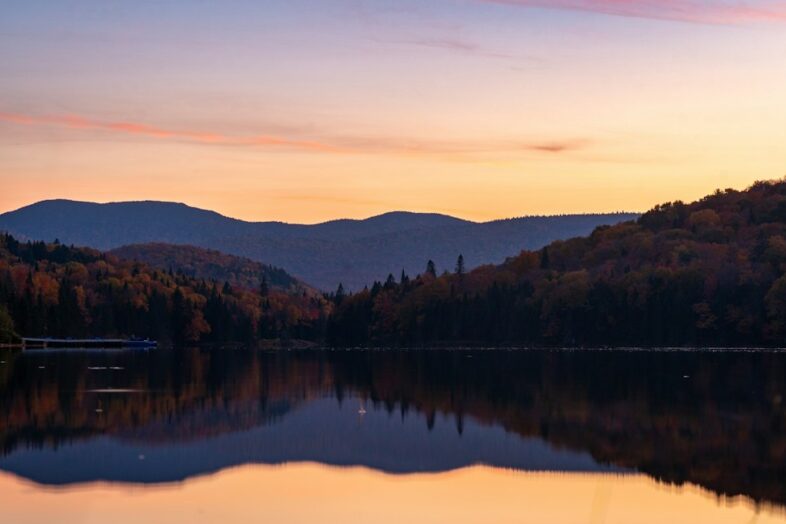
Autumn is peak season for many Montrealers. The combination of mixed forest and countless lakes makes the park one of the best places in Quebec to see fall foliage. Weekends in late September and early October are busy, so arrive early, consider a weekday visit and bring layers: mornings can be close to freezing even when afternoons feel like summer.
Visiting in winter
When snow covers the Laurentides, the park becomes a destination for quiet winter sports. Groomed cross-country ski trails, marked snowshoe routes and Nordic ski itineraries give access to frozen lakes and silent forests, far from the lift lines of the ski hill. Families will appreciate the gentler trails near the main facilities. Check trail conditions before leaving, carry extra warm layers and remember that daylight is short in December and January. For more ideas, see what to do across the region in our guide to the best time to visit the Laurentides.
Camping and where to stay
The park offers a wide range of camping options, from campgrounds with services to rustic and backcountry sites, as well as ready-to-camp tents and cabins in some sectors. Summer weekends and the fall colour season book up quickly, so reserve as soon as your dates are set.
If you prefer a bed and a hot shower, base yourself in the village of Mont-Tremblant or nearby towns and drive into the Diable sector for the day. Our Mont-Tremblant city guide covers the different areas of town, and our selection of the best cabins in the Laurentides is a good starting point if you want a rustic stay with more comfort than a tent.
Getting there and practical tips
The Tremblant area is less than a two-hour drive from Montreal in normal traffic, which makes the Diable sector an easy day trip. The Pimbina and Assomption sectors are reached from different roads, so check your route before you leave and fill up on fuel: services inside the park are limited. If you are planning several stops on the way, our Laurentides road trip itinerary and our list of day trips from Montreal will help you build the route.
- Pay the access fee online or at the entrance; keep proof of payment visible in your vehicle.
- Check sector status: some areas, roads or trails can be closed for maintenance or for the season.
- Bring what you need: water, food, bug spray (especially in June), sunscreen, rain gear and a paper map, as cell coverage is unreliable.
- Respect wildlife: keep your distance, never feed animals and store food properly at campsites.
- Check pet rules before bringing a dog, as restrictions apply in Quebec national parks.
- Leave no trace: stay on marked trails and take your garbage with you.
Sample itineraries
One day
Arrive early in the Diable sector, hike La Roche in the morning, picnic and swim at Lac-Monroe, then walk to the Chute du Diable before dinner in Mont-Tremblant village.
A weekend
Add a guided via ferrata outing or a half-day canoe trip on the Diable River on day two, and camp or stay nearby to catch wildlife at dusk.
Four days or more
Split your time between the Diable sector and the quieter Pimbina or Assomption sectors, or plan a canoe-camping circuit with reserved backcountry sites.
FAQ
Is Mont-Tremblant National Park the same as the Tremblant ski resort?
No. The ski resort and its pedestrian village are a private resort on Mont Tremblant itself. The national park is a separate protected area managed by Sépaq, with its own entrances and fees.
Which sector should I choose for a first visit?
The Diable sector. It is the closest to the village of Mont-Tremblant and concentrates the best-known hikes, beaches, rentals and services.
Do I need to pay to enter the park?
Yes. A daily access fee applies, as in other Quebec national parks, and some activities such as camping, rentals or the via ferrata are charged separately. Check current rates before your visit.
When is the best time to see moose?
Early morning and evening, especially near wetlands, shallow bays and slow rivers. Drive slowly on park roads and keep a safe distance if you see one.
Can I visit the park in winter?
Yes. The park offers cross-country skiing and snowshoeing in winter. Facilities and access points differ from summer, so check which areas are open before heading out.
Conclusion
Mont-Tremblant National Park is the Laurentides at their wildest and most beautiful, yet it remains remarkably accessible from Montreal. Start with the Diable sector, book camping and activities early, and come back in a different season: the same lakes and hills feel like a new destination in summer, fall and winter.